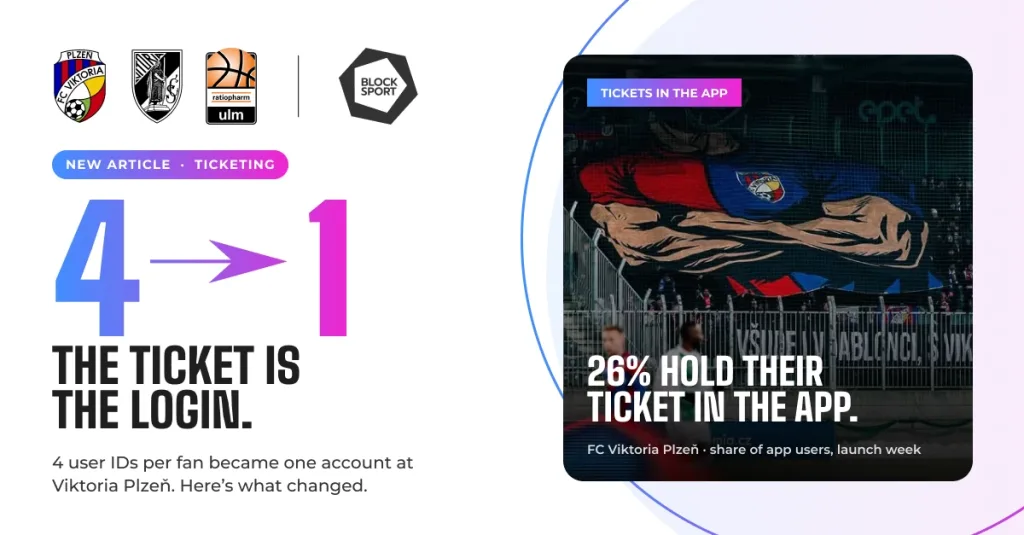
At FC Viktoria Plzeň, one supporter used to exist as four different people. The ticketing system had its own user ID, and so did the fan login, the loyalty programme and the data platform. Every system had a piece of the fan, and none of them had all of it.
That isn’t unusual. Most clubs sell tickets through one provider, sell shirts through another, run a newsletter from a third and post on social channels they don’t own. The ticket is the most valuable transaction a fan makes with the club all season, and it often happens in the system that knows the least about who the fan is.
Three clubs, three ticketing setups, one pattern
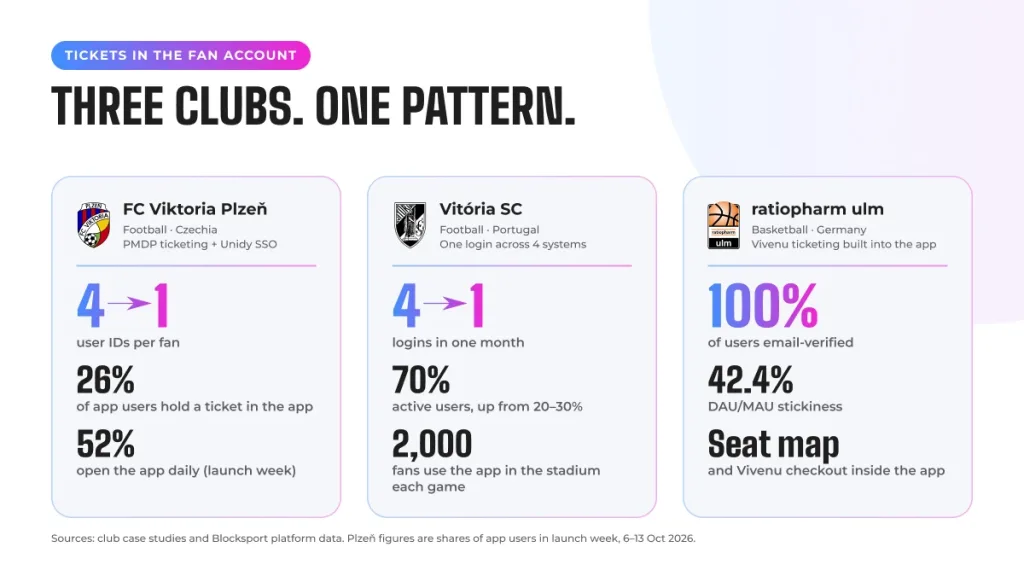
Here are three clubs from three countries, using three different ticketing setups. In all of them the ticket now sits in the same account as everything else the fan does.
- FC Viktoria Plzeň (football, Czechia): PMDP ticketing, signed in through the club’s Unidy SSO. 4 user IDs → 1. 26% of app users hold a season or match ticket in the app; 52% opened the app every day in launch week
- Vitória SC (football, Portugal): Club ticketing joined to one Vitória login with the website, online store and email database. 4 logins → 1 in one month. Active users went from 20–30% to 70%; 2,000 fans use the app inside the stadium every game
- ratiopharm ulm (basketball, Germany): Vivenu ticket shop built natively into the app. 100% of users email-verified, 50% phone-verified; 42.4% DAU/MAU stickiness
Plzeň and ulm didn’t replace their ticketing providers, and neither did Vitória. The ticket shop stayed where it was. What changed is the account it belongs to.
Why the ticket changes everything else
It’s the one reason every fan already has
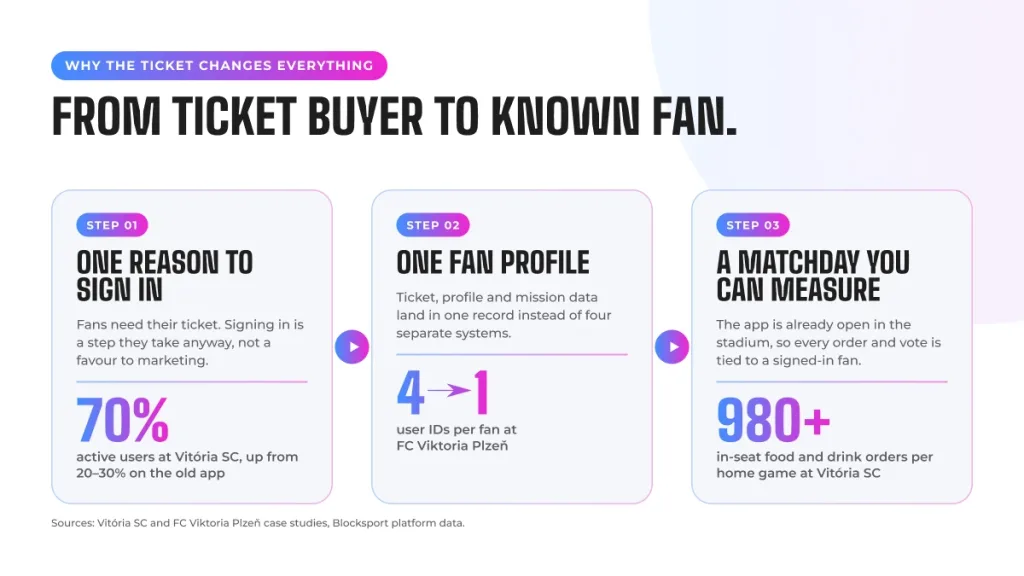
Nobody needs an app to read the news. Fans do need their ticket. When the ticket lives in the app, signing in is a step they’d take anyway, not a favour they do for the marketing team.
Vitória saw this at launch. One of the main drivers of adoption was that the app offered one login fans already needed for tickets and the shop. The app then gave them reasons to come back every matchday, such as MVP voting, quizzes and points. Active users went from 20–30% on the old app to 70% on the new one.
It turns a buyer into a known fan
A ticket bought in a separate system produces a transaction. A ticket held in the fan account produces a profile. It shows who bought, which competition they follow, whether they hold a season pass, and what else they do between games.
At Plzeň, missions in the same app reward fans for completing profile data such as nickname, photo, name and email. That data lands in the club’s Boldem CDP next to the ticket record, not in a separate silo. One fan, one ID, one view.
It switches the app on at the stadium
The ticket brings the fan into the ground with the app already open. From there, matchday becomes something the club can measure.
At Vitória, 2,000 fans use the app inside the stadium every game. A push notification fires during every match, and fans place 980+ food and drink orders per home game from their seats. Every order is tied to a signed-in fan, so the club knows who ordered, what they ordered and when.
The push is possible because the club knows that fan is in the building.
What this means for the commercial side
For a CMO or CCO, the ticket in the fan account answers questions that are usually guesswork:
- Who is actually in the building? Not just the buyer’s email, but a signed-in fan with a history.
- Who are the season-ticket holders, and what do they do between games? Plzeň’s 26% is a segment the club can now see, message and reward directly.
- What does a matchday fan spend beyond the ticket? Vitória’s 980+ in-seat orders per game are attributable, not anonymous till receipts.
- What can a sponsor be offered? A verified, in-stadium audience on matchday, instead of a logo on a concourse screen.
It also changes what can be sold next. Plzeň’s shared roadmap includes a Premium subscription for season-ticket holders and priority food and drink ordering at the stadium kiosks. Both products start from the same thing: the club knows which fans hold a ticket.
Connect, don’t replace
The usual objection from a CEO or digital director is “we already have a ticketing provider, and we’re not switching.” None of these three clubs did.
- Plzeň kept PMDP ticketing, Unidy SSO, the Boldem CDP and the Viktorian loyalty programme. Blocksport connected them into one SuperApp.
- ulm kept Vivenu. The ticket shop, seat map and checkout run natively inside the app.
- Vitória got single sign-on across ticketing, website, online store and email database in one month, and the full SuperApp in two.
The ticketing contract stays the same. What changes is that the fan stops being four strangers to the club.
The budget conversation
When an app is costed as a content channel, it competes with the website for budget, and it usually loses. When it’s costed as the place where the ticket lives, the discussion shifts. It’s the account every matchday fan opens, the data source for every season-ticket decision, and the shop window for whatever the club sells next, from food at the seat to a Premium tier.
The numbers above come from three clubs with different sports, countries and ticketing providers. The pattern holds across all three: once the ticket moves into the fan account, the club learns who its fans are.
Figures: FC Viktoria Plzeň case study and Blocksport platform data (shares of app users, launch week 6–13 October 2026), Vitória SC Case Study 2026 and platform data, ratiopharm ulm Case Study 2026. Stickiness = daily actives ÷ monthly actives.