90%. That’s how many fans at F.C. Famalicão started a mission inside the club’s app. Half of them finished it. That 40-point drop between “started” and “completed” isn’t a failure metric — it’s a data acquisition funnel, and it behaves exactly like one.
Most clubs treat gamification as an engagement toy: badges, points, a leaderboard nobody checks twice. But run the numbers across eight different clubs and federations, and a different picture appears — missions are the single most reliable mechanism clubs have for turning anonymous app installs into verified, permissioned fan records.
The math, club by club
Every mission funnel we’ve tracked follows the same three-stage shape: participation, progression, completion — and at each stage, the fan hands over more data in exchange for more reward.
AS Monaco Basketball: 5,637 entered the funnel → ~5,000 progressed → 400+ became “Super-Fans”
F.C. Famalicão: 90% started missions → 50% completed
Qarabağ FK: 95% engaged → 85% progressed → 90% converted at final stage
Kaizer Chiefs FC: 90% entered → 82% progressed → 70% completed
Tonybet Virslīga: 85% participated → 90% of participants earned points
OH-Leuven: 97% entered loyalty funnel → 92% progressed → 87% completed
Six clubs, three different leagues, two different sports, and the funnel shape barely moves. That consistency is the point — this isn’t a one-off campaign result, it’s a repeatable mechanic.
Why this works: the mechanism behind the numbers
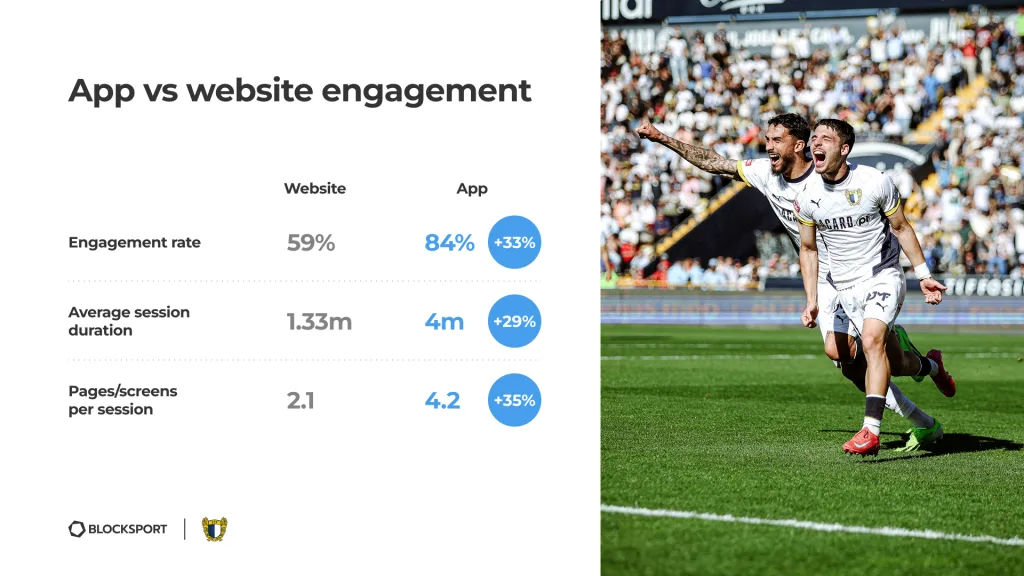
A social media follow costs a fan nothing and tells a club nothing. A completed in-app mission is different — each step typically asks for one more piece of verifiable data (email, birth date, location, a preference field) in exchange for a reward (points, a badge, entry into a raffle, unlocked content). The fan isn’t handing over data because they were asked nicely. They’re handing it over because they’re already three steps into a funnel and the next step is small.
That’s why the drop-off between stages matters more than the headline participation number. AS Monaco’s funnel narrows from 5,637 to 400+ “Super-Fans” — a steep taper, but those 400+ are fans who’ve been verified and re-verified at every stage, which makes them worth far more per record than the 5,637 who merely opened the app once. Platform-wide, that’s consistent with the 100% verified email rate and 70% opt-in rate for data sharing that clubs running this mechanic see overall.
What this means if you’re the one signing off on the budget
If you’re a Digital Director evaluating whether gamification is worth building, the question isn’t “will fans play a game inside our app.” It’s “how much CRM-grade data will each completed mission generate, and at what cost per verified record.” The funnel math above answers that directly: at Famalicão, half of everyone who opens a mission finishes it — that’s a 50% conversion rate on a data-collection mechanic, which no email signup form or social contest will get close to.
For a CMO, the number that matters is downstream: Qarabağ’s mission funnel (95% → 85% → 90%) sits inside a broader engagement jump from 20% on social to 65% in-app. The missions aren’t incidental to that jump — they’re a primary driver of it, because they give fans a reason to open the app repeatedly rather than once.
The budget conversation this should change
Most clubs still ask for gamification quotes the way they’d ask for a website widget — a nice-to-have line item. The funnel data says otherwise: this is a data-acquisition system with a measurable, repeatable conversion rate, sitting inside six different fan bases across two sports. The conversation worth having isn’t “can we afford a missions feature.” It’s “what’s our cost per verified fan record without one, and does that number look better or worse than 50-90% funnel completion.”