Azerbaijan is not, by most measures, a “big” football market. Qarabağ FK plays in a country with a fraction of the population of England or Italy, competes in a league most European fans couldn’t name, and has shared a UEFA Champions League group stage with clubs that outspend it many times over on wages alone. And yet inside the club’s own fan app, Qarabağ is running engagement numbers that plenty of Europe’s household names would be glad to show their board.
Before working with Blocksport, Qarabağ’s relationship with its fanbase looked like most clubs’: almost entirely social-media-driven, sitting around a 20% engagement rate, with no reliable way to know who was actually paying attention or how to reach them directly. Today, inside a verified, club-owned fan app, that number sits at 65%.
That’s not a small tweak. That’s more than triple.
The numbers behind the headline
- Engagement: 20% (social media, before the app) → 65% (in-app, verified audience)
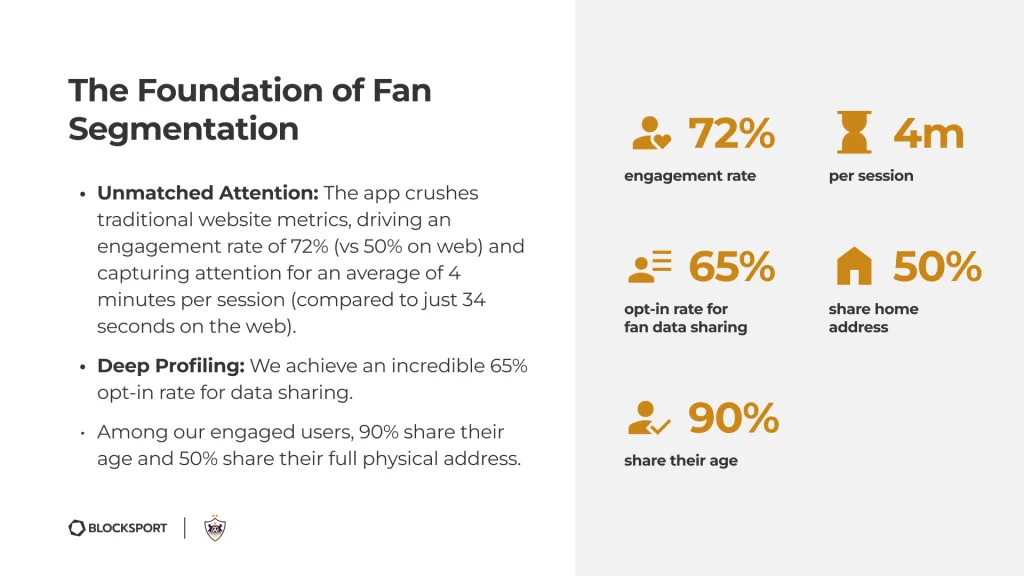
- Even against the club’s own website, the app runs hotter: 72% engagement versus 50% on web, with a 4-minute average session compared to just 34 seconds on the site
- Fan missions: 95% of app users start a mission, 85% finish one, and 90% actively earn fan points
- Data acquisition: 65% opt-in rate for data sharing overall, with 90% of engaged users sharing their age and half sharing a full home address
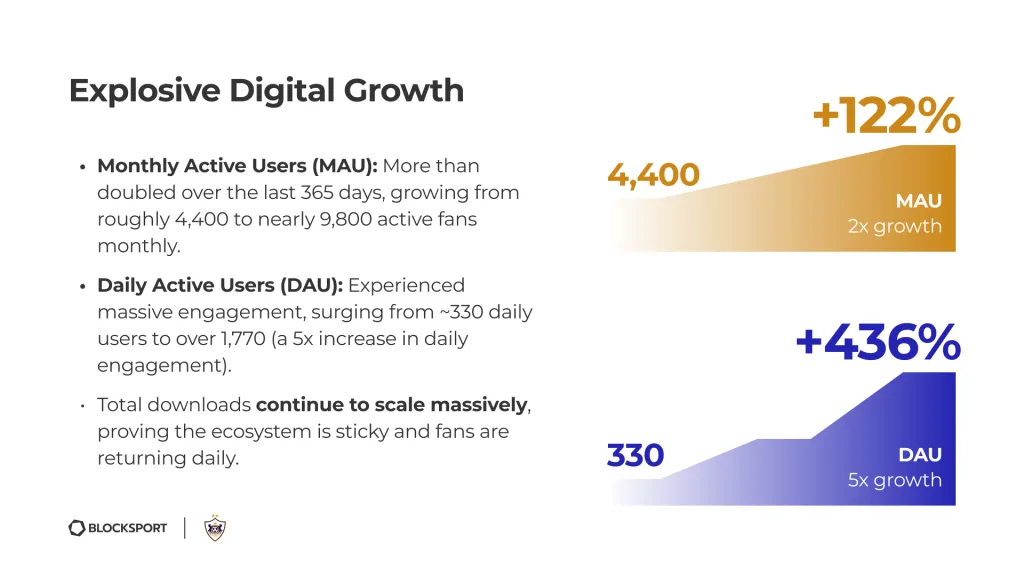
- Growth over 365 days: Monthly Active Users more than doubled, from 4,400 to 9,800 (+122%); Daily Active Users grew over 5x, from 330 to 1,770 (+436%)
None of that required Qarabağ to out-budget anyone. It required moving fans off platforms the club doesn’t own and into one it does.
Why “smaller” doesn’t mean “can’t”
Qarabağ is what a sales team would call a Tier 2 account: a sizeable, genuinely passionate fanbase, competitive at a real continental level, but without the layers of procurement bureaucracy or long-standing sponsor lock-ins that make deals with Europe’s mega-clubs slow and complicated. That combination, real ambition without mega-club bureaucracy, is exactly why a digital transformation like this can move fast enough to post these numbers inside a single year.
The mechanism itself isn’t complicated. A passionate fanbase with no verified channel is a marketing department flying blind: real emotional investment in the club, but no way to reach it directly, segment it, or prove it to a sponsor. Qarabağ already had the passion. What it didn’t have was a direct line to it. Fan missions, a points and ranking system, and a premium subscription tier (unlocking VIP voting, closed fan chats, and double points for the club’s most dedicated supporters) gave fans a concrete reason to move from “following on Instagram” to “logged in and identified.” The data above is what happens once that shift happens at scale.
There’s also a sponsor angle worth noting: Qarabağ integrated a betting partner directly into its in-app match-prediction feature, turning a fan engagement tool into a sponsor placement, rather than treating sponsorship and fan engagement as two separate workstreams.
The sustainability framing, and why it matters to a board
Qarabağ has also framed the shift in three parts that map cleanly onto how a president or CEO evaluates any capital decision: sporting sustainability (data-driven fan support feeding long-term club growth), financial sustainability (new digital revenue streams that don’t depend on matchday ticket sales alone), and environmental responsibility (digital ticketing and in-app assets reducing reliance on physical goods). None of those three require a bigger transfer budget. They require a platform that turns existing fan passion into something measurable.
What this proves for a budget conversation
The usual assumption is that digital transformation is a scale game, that only clubs with the marketing departments of FC Barcelona or Bayern Munich can pull off a jump like this. Qarabağ’s numbers argue otherwise. A club from a market most global sponsors have never specifically budgeted for turned a 20% social-media engagement rate into 65% verified in-app engagement, more than doubled its monthly active user base, and built a premium subscription tier that fans actively pay into, inside a single year.
The financial case for a dedicated fan platform doesn’t need a mega-club’s marketing spend to work. It needs a fanbase that’s already passionate, which most clubs already have, and a channel built to actually capture and reward that passion, which most clubs don’t yet have. Qarabağ had the first part from the start. Building the second is what closed the gap with clubs that outspend it many times over.