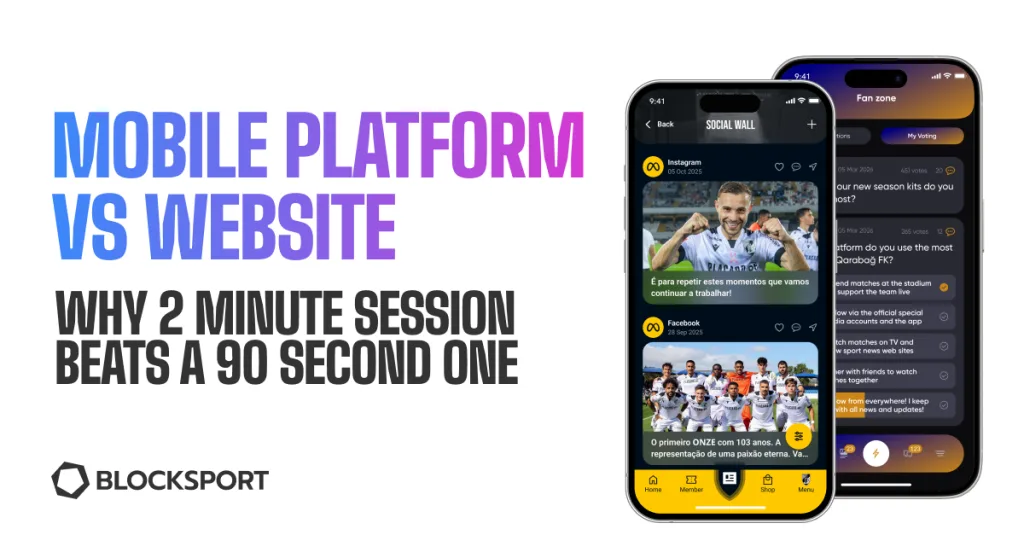
Most clubs already have a website. Most already post on Instagram, TikTok, and X. So when a Digital Director or CMO gets asked to justify a dedicated fan app, the question that comes back is fair: what does an app actually do that a good website doesn’t?
The honest answer, based on real usage data from three clubs already running one, is: it changes how long a fan stays, how much of the club they see while they’re there, and how likely they are to hand over data on their way out. None of that is a matter of opinion. It’s measurable.
The comparison, club by club
- OH-Leuven FC: 92% engagement in-app vs. 59% on the website (+33 points). Average session 2 minutes vs. 1m 33s (+29%). 3.2 screens per session vs. 2.1 (+35%).
- F.C. Famalicão: 84% engagement in-app vs. 59% on the website. Average session 4 minutes vs. 1m 33s. 4.2 screens per session vs. 2.1.
- Qarabağ FK: 72% engagement in-app vs. 50% on the website. Average session 4 minutes vs. just 34 seconds on the website — nearly a 7x gap.
Qarabağ FK is the one worth sitting with. A 34-second website session versus a 4-minute app session isn’t an incremental improvement, it’s a different order of magnitude, and it happened while the club was also lifting overall engagement from a 20% baseline on social media to 65% inside the app with a verified audience.
Why the gap exists
A website session is a lookup. Someone wants a fixture time, a ticket link, a score. They get it and they leave. There’s nothing structurally wrong with that; it’s what websites are for. An app session is a visit, and three things make the difference:
- It’s already in their pocket. A push notification about a fan mission, a live poll, or a match update reaches someone who already has the app installed. A website has to be actively navigated to, every time.
- There’s something to do, not just something to read. Quizzes, MVP voting, match predictions, and fan missions give a reason to stay past the initial reason for opening the app. A news article ends. A leaderboard doesn’t.
- It remembers who you are. Fan Points, rankings, and mission progress carry over session to session. A website visitor starts from zero every time; an app user picks up where they left off.
Why this matters more than it sounds like it should
A longer session isn’t a vanity metric if you know what to do with the extra time. Two things happen inside that extra 90 seconds to 3.5 minutes that don’t happen on a website visit:
- More screens means more sponsor inventory. Every additional screen a fan moves through is a placement opportunity: ad banners, “presented by” content blocks, sponsored missions. A club showing 4.2 screens per session instead of 2.1 is showing roughly double the inventory for the same visit.
- More time means a higher completion rate on data-sharing actions. Fan missions that ask someone to share an email, confirm an age range, or opt in to marketing take more than 34 seconds to complete. A fan who stays for 4 minutes has time to finish that flow; a website visitor who leaves in under a minute never did.
This is the direct link between session length and the numbers CMOs actually care about: OH-Leuven’s app pushed opt-in rates for verified personal data past 70%, and Qarabağ’s app users share their age 90% of the time and a full home address half the time. Neither happens in a 34-second visit.
The budget conversation this settles
The usual objection to a dedicated app is that the website “already does most of it.” The data above says the opposite: the website and the app aren’t doing the same job. The website is a lookup tool. The app is where a fan actually spends time with the club, and time is the raw material every downstream number, engagement rate, data opt-in, sponsor impression, loyalty completion, is built from.
If the goal is a longer relationship with a fan than a single fixture check, the data from three separate clubs, across two leagues and three countries, points the same direction: the app isn’t a nicer version of the website. It’s a different product doing a different job, and it’s the one that keeps fans around long enough to matter.