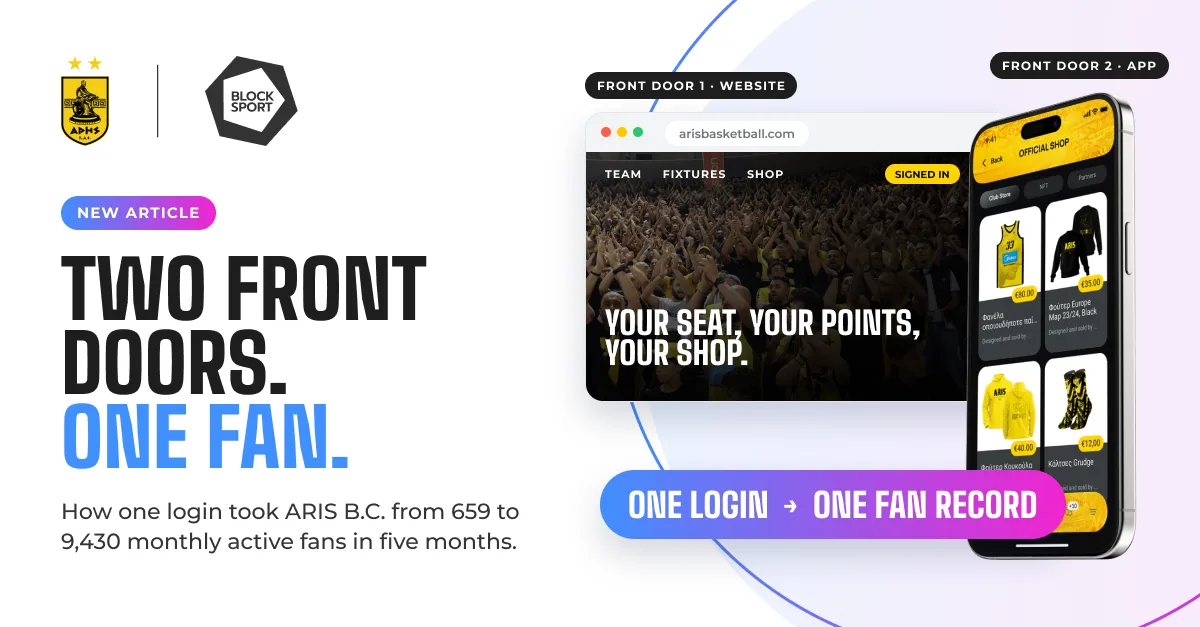
In February 2026, ARIS B.C. had 659 monthly active fans in its app. It also had a club website, an online shop and a CRM. Each one had its own front door and its own login.
That meant the club could not tell whether the person buying a jersey on the website was the same person voting for MVP in the app. Five months later, it can tell for every one of 13,955 fan records. The app had 9,430 monthly active fans in July, and the thing that changed was not a feature. It was the login.
The numbers, before and after
ARIS relaunched its SuperApp on Blocksport’s Single Sign-On in March 2026. In June, the club website moved onto the same login. Monthly active fans:
- February 2026: 659, with separate logins for website and app
- March 2026: 6,610, after the app relaunched on SSO
- May 2026: 5,656, with the app on SSO and the website still separate
- June 2026: 9,473, the month the website joined the shared login
- July 2026: 9,430, off-season with no league fixtures
The June step came from a login change, not a new feature. And it held through July, when 68% of monthly active fans still opened the app every week.
What the club now owns:
- 13,955 identified fan records in one database
- 95% with a verified email
- 1,796 phone numbers captured
- 68% of all registered fans active every month
Vitória SC shows the same pattern with a football club. One SSO now covers ticketing, the website, the online store and the email database, and it was delivered in one month. It has passed 24,000 registrations, and the SuperApp on top of it signed up 5,000 users in ten days. That’s half the old app’s two-year total.
Why one login changes the numbers
Every account counts once. Two logins turn one fan into two partial records. With SSO, website and app sign-ins land on the same profile, and existing accounts are migrated into it, not started from zero.
Every channel feeds the fan’s profile. App points, shop purchases and website preferences all go to one profile, so fans pick up where they left off. ARIS fans averaged 8.3 sessions and 18.8 screens each in July, with no games to bring them back.
Signing in is easy, so fans do it. Fans sign in once with email, Apple, Google or Facebook and are recognised everywhere. Blocksport’s SSO supports the OpenID protocol, so connected ticketing and merchandise systems can plug in rather than being replaced.
What this means for the Digital Director
Identity comes before features. Missions, polls, premium tiers and sponsor zones all assume the club knows who the fan is. Built on split logins, each of them only reaches part of the audience.
Sponsor reporting becomes provable. ARIS’s Uber Zone works as a sponsor product because every fan is signed in. Redemptions are tied to a person, not estimated from impressions.
The numbers survive a board meeting. With one record per fan, every metric has one source and one definition. By ARIS’s definition of an engaged session, 84% of its 77,840 July sessions qualified.
The budget conversation
SSO usually gets filed as plumbing: expensive, invisible and slow. Vitória answers “slow”: in Rui Xavier’s words, “What others could not do in five years, they did in one month.” ARIS answers “invisible”: its monthly active fans rose in the month the website joined the shared login.
The real cost is keeping four systems that each hold part of the same fan. One login doesn’t add a channel. It makes the club’s existing channels work as one audience it can count, and sell.
Sources: ARIS B.C. case study (August 2026) and Vitória SC case study (2026), Blocksport.