A last-minute winner goes in. Your club posts the clip. Forty thousand likes in an hour, hundreds of comments, a share count climbing all night.
By tomorrow morning, you know precisely none of those forty thousand people. Not an email. Not a phone number. Not a birthday to trigger a matchday promo. Nothing. The biggest moment of your season just happened on a platform that will never hand you a single verified fan.
The Conversion Gap
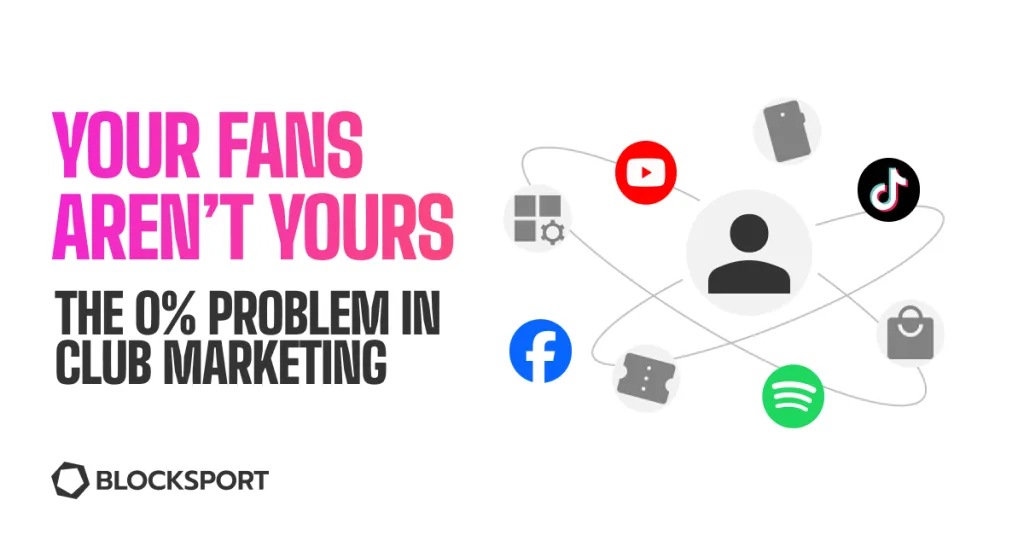
That’s the 0% problem. Sports organizations are exceptionally good at generating attention and structurally unable to keep any of it. Two numbers make the shape of the gap clear:
- 67% of sports organizations report they lack the internal expertise to collect fan data at all, and roughly three in four fan interactions never make it anywhere near a sale, a sign-up, or a verified profile.
- At Vitória SC, even a fast, well-executed SuperApp launch — 5,000 new users in the first ten days, more than half of what the club’s old app had accumulated in two full years — converted only 15% of the club’s social media followers into app users. The other 85% engaged, reacted, commented, and stayed exactly where they started: on a platform the club doesn’t own.
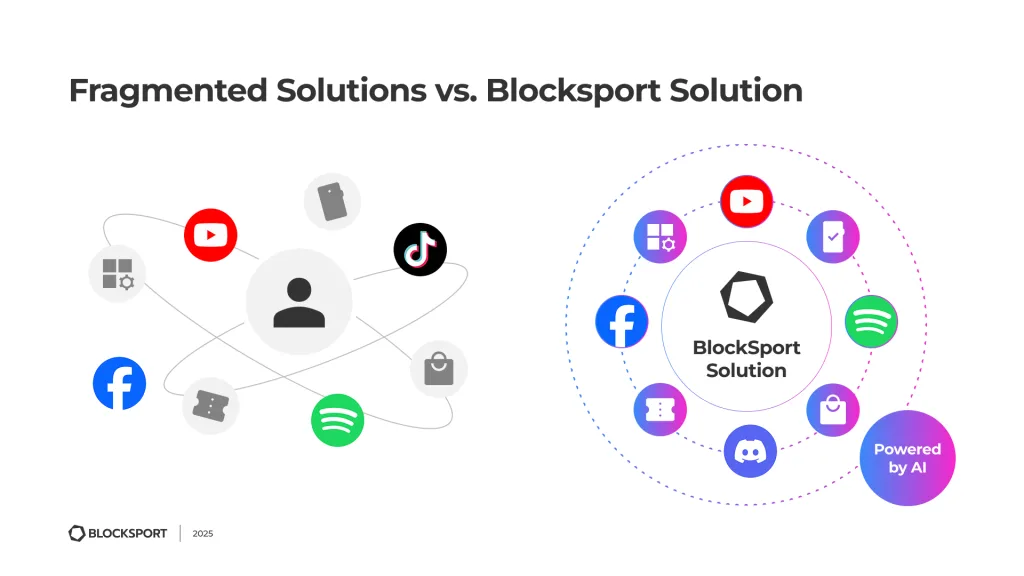
The gap isn’t a failure of content or fan passion. It’s structural. Social platforms are built to keep the relationship between the platform and the fan — not between the club and the fan.
Why Social Engagement Stays at Zero
A like doesn’t carry a phone number. A comment doesn’t carry a verified email. Instagram, TikTok, and Facebook are excellent at surfacing content to an audience the club has effectively rented, and the algorithm — not the club — decides who sees it, when, and for how long. No amount of posting frequency changes what data comes back: none.
Qarabağ FK shows what happens when a club changes the venue for that engagement rather than the content itself. Before moving fan interaction into an owned channel, in-app engagement sat at 20% relative to social. After, verified in-app engagement climbed to 65% — a 45-point shift from “watched somewhere else” to “known, reachable, and segmentable by the club itself.”
The mechanism is simple: an owned digital channel exchanges something the fan wants — missions, points, predictions, exclusive content, one-tap login — for something the club needs, which is a verified identity. Once that exchange happens inside a platform the club controls, the numbers look nothing like social:
- 70% opt-in rate for fan data sharing, as a platform-wide benchmark
- 100% of registered accounts carry a verified email
- 70% share a phone number, 50% share a home address
No Instagram post, however viral, produces a single one of those numbers.
What Zero Percent Costs a CMO
For a CMO or CCO, the 0% problem shows up first as rising acquisition cost. If three in four engagements never convert into anything measurable, every campaign resets to zero the moment the algorithm changes, the ad rates increase, or the platform deprioritizes organic reach. There’s no compounding asset being built — only rented reach, paid for again next month.
It shows up a second time in sponsor conversations. A sponsor asking “who actually saw this, and can you prove it converted?” cannot be answered with impression counts scraped from a platform the club doesn’t control. Verified, segmentable, first-party fan data is the only answer that holds up in a renewal negotiation — and it only exists on the club’s own channel, never on someone else’s feed.
The Budget Conversation This Actually Is
The real question isn’t “should we build an app.” Most clubs are already spending against this problem every month, just badly — boosting posts, running ad campaigns, paying to reach an audience that resets to zero reach the day the algorithm shifts again.
The alternative isn’t a bigger media budget. It’s redirecting a slice of that spend toward a channel the club actually owns, one built to convert hype-moment attention into a verified, growing database instead of a vanity metric. A Starter deployment launches within 60 days at €0 setup fee, priced per active monthly fan rather than as a fixed cost — which means the investment scales with the audience the club is actually converting, not the audience it’s merely renting.
The forty thousand likes were real. The question is how many of them the club still has a way to reach next season.