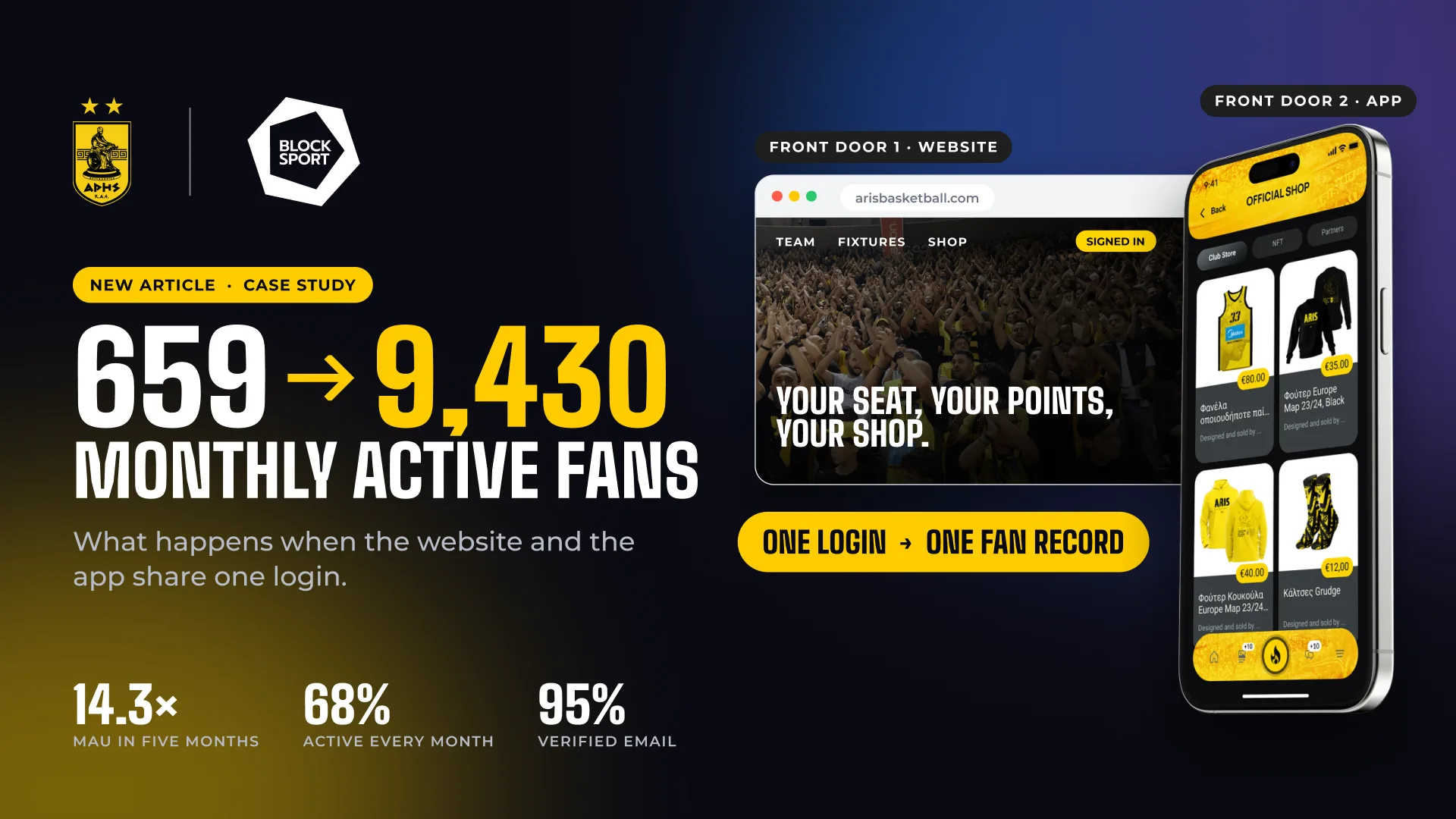
659 monthly active fans in February. 9,430 in July. Same club, same city, same supporters. ARIS BC didn’t buy a bigger audience in those five months. It stopped splitting the one it already had.
Until 2026, the Thessaloniki basketball club ran two front doors: the official website and a standalone SuperApp, each with its own account and its own login. A supporter who bought a shirt on the web and checked fixtures in the app looked like two different people, or more often, like nobody in particular. Most clubs live with this without noticing. It’s the default setup.
The numbers, before and after
The app was relaunched in March 2026. In June, the club website moved onto the same login. Each launch shows up as its own step in the growth curve, and the level has held since.
- Monthly active fans: 659 (Feb 2026) → 9,430 (Jul 2026), a 14.3× increase
- Identified fan records: 13,955, all in one database, 95% with a verified email
- Penetration: 68% of all registered fans open the app in a given month
- Stickiness: 6,389 of 9,430 monthly actives also open it in a given week (68%)
- Engaged sessions: 65,573 of 77,840 sessions (84%) passed the engagement threshold, not bounces
- Depth: 8.3 sessions and 18.8 screens per active fan in July
- Attention: 2,436 hours spent inside club-owned inventory in July alone
- Store rating: 4.9★ on Google Play across 1,720 reviews
The detail that matters most: July is the quietest month of the basketball year. No league fixtures, nothing on the calendar to pull people in. Two in three registered fans showed up anyway.
Why one login changes the maths
Single sign-on sounds like plumbing. Commercially, it’s the step that turns traffic into people.
When a website and an app each keep their own accounts, three things quietly break.
You count visits, not fans. Two systems means two partial profiles per supporter, and no reliable way to join them. Your “audience” is a sum of sessions.
Every new feature starts from zero. A shop, a loyalty scheme or a ticketing flow launched on one side has no idea what the fan did on the other.
Sponsors get estimates. Without a signed-in person behind each interaction, activation can only be inferred from impressions.
With Blocksport SSO, the ARIS BC website, SuperApp, eShop and CRM sit behind one identity, and every interaction is written to the same profile in the Cockpit Hub. A fan signs in once, with email, Apple, Google or Facebook, and is recognised everywhere. Phone in the stand or laptop at home: same login, same points balance, same record.
ARIS also did something many migrations skip. Existing accounts were folded into the single record rather than reset, so the club kept every fan it had already earned. Then it launched on a moment, going live against a fixture the whole city was watching and adding thousands of fans in a single day.
What kept them coming back after launch day was a reason to return. Fan missions, levels and matchday content turned a one-off download into a weekly habit, and every mission step doubled as a data step:
- Started a fan mission: 97%
- Completed their first mission: 60%
- Shared their phone number: 52%
- Opted in to marketing: 68%
The same pattern holds elsewhere. At Qarabağ FK, 95% of users started fan missions and 85% completed them, and the app captures 4 minutes per session against 34 seconds on the club website. Unifying identity is what lets that depth accumulate on one record instead of scattering across systems.
What a commercial team actually gets
Reach is easy to buy. Proven return visits per named fan are not, and that’s what sponsors renew on.
Uber became an official ARIS BC sponsor in April 2026. Instead of a logo placement, the deal took a permanent zone inside the app: 20% off two rides, to the game and back, unlocked with the code ARIS_20. Because every fan opening that zone is signed in, each redemption is attributable to a person rather than estimated from impressions. And the zone is a template. The next sponsor can get the same treatment without new development.
Once one identity spans every touchpoint, each new revenue line becomes a configuration rather than a rebuild. For ARIS BC, the next four are already scheduled:
- Premium membership tier: Q3 2026, aimed at a segment that’s already identifiable because stickiness is measured per person
- Official eShop inside the app: October 2026 season opener, selling to signed-in fans whose loyalty level and history are already known
- Business Hub for sponsors: Q4 2026, self-serve campaign space with a reporting view that makes renewal a data conversation
- Ticketing and matchday integration: 2026/27 season, closing the loop from fan record to seat to spend
The budget conversation
Most digital budgets are still set per channel: a website line, an app line, a CRM line, a sponsorship deck. ARIS BC shows why that framing undersells what’s actually being built.
The output of these five months wasn’t a better app or a better website. It was 13,955 fan records the club owns outright, 95% reachable by email, with two in three active every month and every sponsor interaction tied to a name.
The club’s target for 2026/27 is 28,000 registered fans and 20,000 monthly actives. Those are goals, not forecasts. The difference is that the starting point is a known, reachable base instead of a guess.
If your website and app still ask supporters to log in twice, the more useful question isn’t which channel deserves more budget next season. It’s how many of your fans you can actually name.
Figures: Firebase (active fans, sessions, screens, session length; iOS + Android), Blocksport Cockpit Hub (fan records, email and phone coverage), App Store and Google Play (downloads, rating). All as at 31 July 2026 unless stated. Engaged session = over 10 seconds, a conversion, or two or more screens. Stickiness = weekly actives ÷ monthly actives.