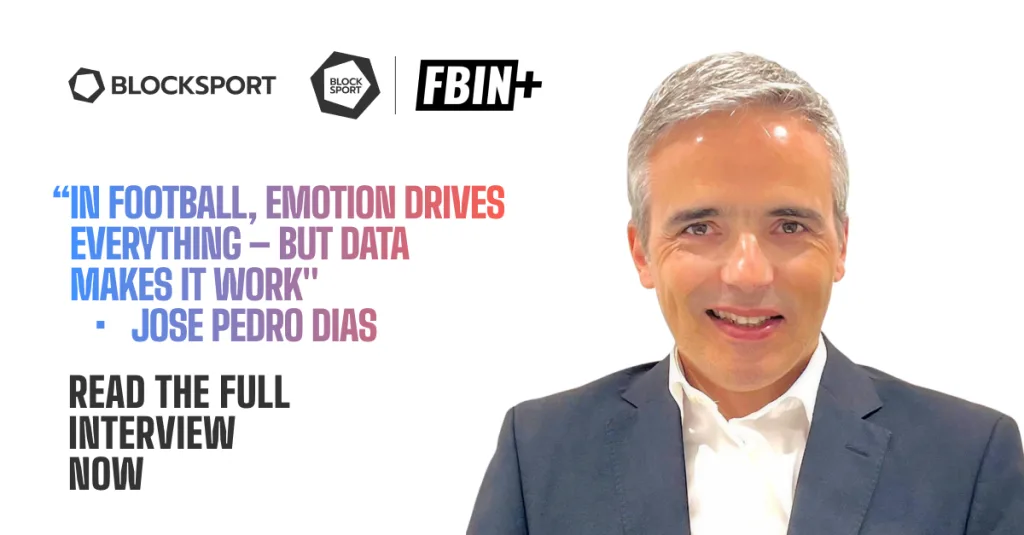
From technology to top-tier football, José Pedro Dias has built a career on bridging two worlds that increasingly rely on each other. After nearly ten years at FC Porto, where he served as Commercial Director, Dias José Pedro joined Blocksport as Head of Sales — bringing both a commercial and technological mindset to help clubs embrace digital transformation.
From Technology to Football
Before entering the sports industry, José Pedro spent nearly two decades in telecommunications and IT, leading commercial strategy and partnerships at Cisco, Huawei, and Siemens. In 2015, he accepted the opportunity to join FC Porto — a decision driven as much by emotion as by career ambition.
“The chance to work with the club of your heart is irresistible,” he recalls. “My challenge was to professionalize the sales department—bringing people and processesfrom the corporate world into football.”
The shift revealed fundamental differences between football and other industries.
“In football, emotions drive decisions far more than processes do,” he says. “There’s no direct competition—fans don’t switch clubs like they switch mobile networks. And our services aren’t essential; people don’t need football to live, but they choose it because of emotion. That makes pricing and engagement completely different.”
Understanding a Changing Fan Base
Over the past decade, Dias has observed how fans’ expectations and behaviour have evolved.
“Ten years ago, fan interaction was transactional—buying tickets, renewing memberships, purchasing merchandise,” he explains. “Now it’s about emotional, two-way engagement. Fans expect daily interaction and personalised content, not just on matchdays.”
According to José Pedro, clubs that fail to adapt risk losing control of their audiences to external platforms.
“Clubs must own their audience and move away from over-reliance on third-party platforms,” he notes. “The challenge now is to have fans engaging with the club’s own app every day.”
This evolution marks a broader shift from transactions to relationships, where digital tools play a central role in shaping loyalty.
Solving the Data Fragmentation Challenge
When speaking with clubs, Dias finds that fragmented data remains one of their biggest obstacles to progress.
“Sometimes a club has two or three CRMs and multiple databases,” he says. “Data fragmentation is a huge challenge. Blocksport helps solve this by putting the fan at the centre of the ecosystem.”
He describes the company’s platform as the club’s digital home, capable of consolidating systems and creating a unified experience.
“Having social-media accounts or a website is not enough. A real digital relationship means identifying, understanding, and interacting directly with each fan—not through intermediaries like Instagram or TikTok.”
For Dias, data is no longer a byproduct of engagement — it is the foundation for it.
“Data is the new stadium. Just as clubs invest in physical arenas, they must invest in systems to collect, store, and activate first-party fan data.”
Why Clubs Choose Blocksport
José Pedro joined Blocksport in 2025 after hearing strong recommendations from several of the company’s clients, including Vitória SC and FC Famalicão.
“The feedback I heard from clients was extremely positive,” he says. “And the team’s mindset—open, flexible, and positive—made the decision easy.”
Blocksport’s main differentiator, he explains, is its ability to transform online audiences into tangible, long-term value.
“Blocksport transforms digital followers into loyal, monetisable communities. We help sports organisations scale their business into the digital era—benefiting clubs, fans, and sponsors alike.”
The company also provides clear evidence of return on investment.
“If a club has ( for example ) one million Instagram followers, we can prove that a certain percentage can be converted into premium subscribers. That means clubs can quickly recover their investment in the platform.”
Adapting to Generational Change
Different generations engage with football in different ways, and digital strategy must reflect that diversity.
“Older generations were passive consumers—buying tickets, reading newspapers,” Dias says. “Younger fans are active participants. They play fantasy leagues, engage in gaming, collect digital items, and spend money on experiences rather than products.”
Blocksport’s platform aims to create one digital environment that serves both.
“We create one digital home where every fan, older or younger, can engage in their own way,” he explains. “Older fans value information and loyalty, while younger fans seek interaction, gamification, and personalisation. Our platform respects the emotional heritage of sport while translating it into the language of technology.”
Looking Ahead
Dias believes that football is finally ready to embrace Web 3.0 technologies, from fan tokens to shared digital ecosystems.
“Three or four years ago, it was too early,” he says. “Now we’re at the right moment to move forward—developing tokens and shared ecosystems across clubs.”
His long-term vision reflects that ambition.
“In ten years, Blocksport will be the operating system of fan engagement, powering the entire world of sport and connecting all its parts.”